
Building Lemuria: A Bleeding-Edge Stack for Deployment to the Edge
Lemuria is a social platform I built as a portfolio piece and learning project, meant to demonstrate the whole arc of product development from schema design to deployed frontend. It’s live now at lemuria.pages.dev. This is an account of what I learned along the way, and in a couple of cases, what I got wrong before I got it right.
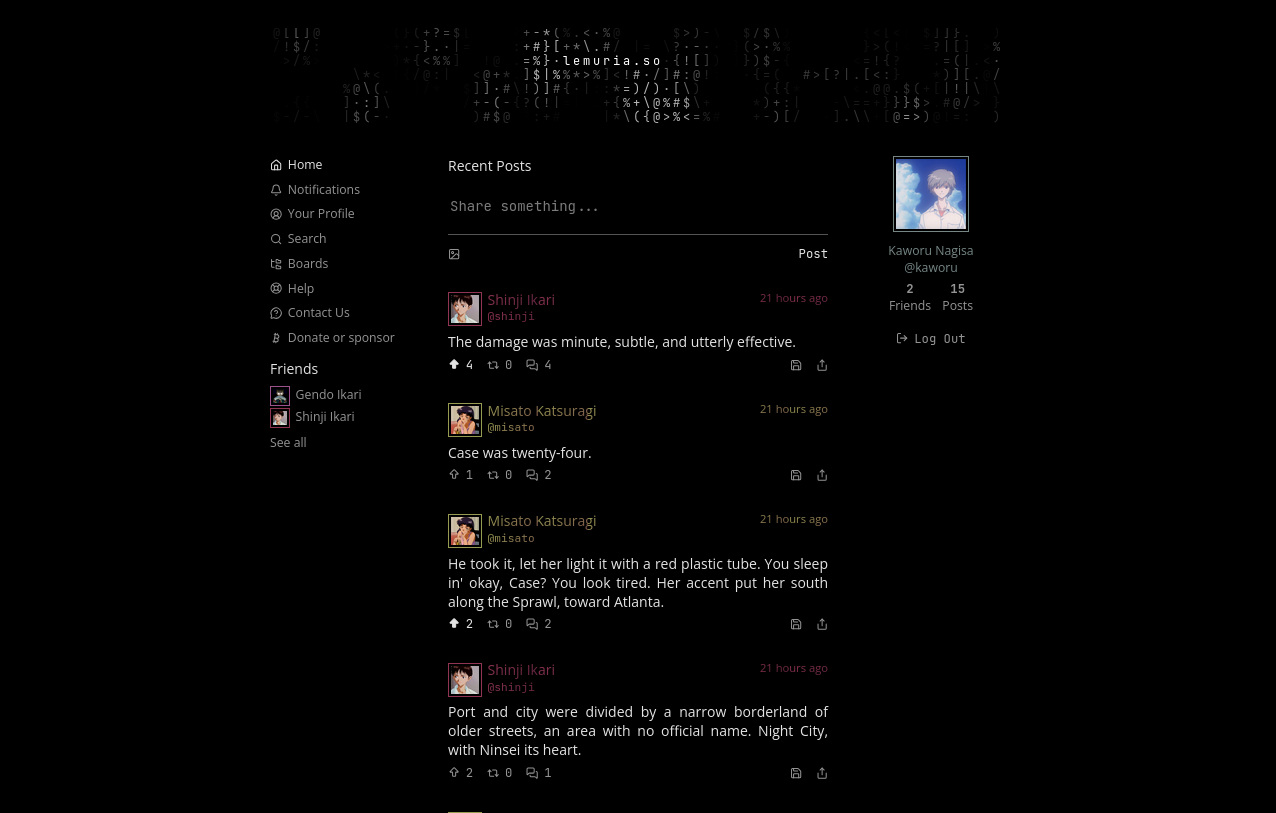
Product
Most social platforms are follower graphs. One user follows another without reciprocation, and the model produces the dynamics with which we are all well accustomed: audience-seeking, performance, and low-quality connection.
Lemuria uses two-sided friendships - both users have to accept - which is a deliberate constraint meant to keep communities smaller and make connections feel like something.
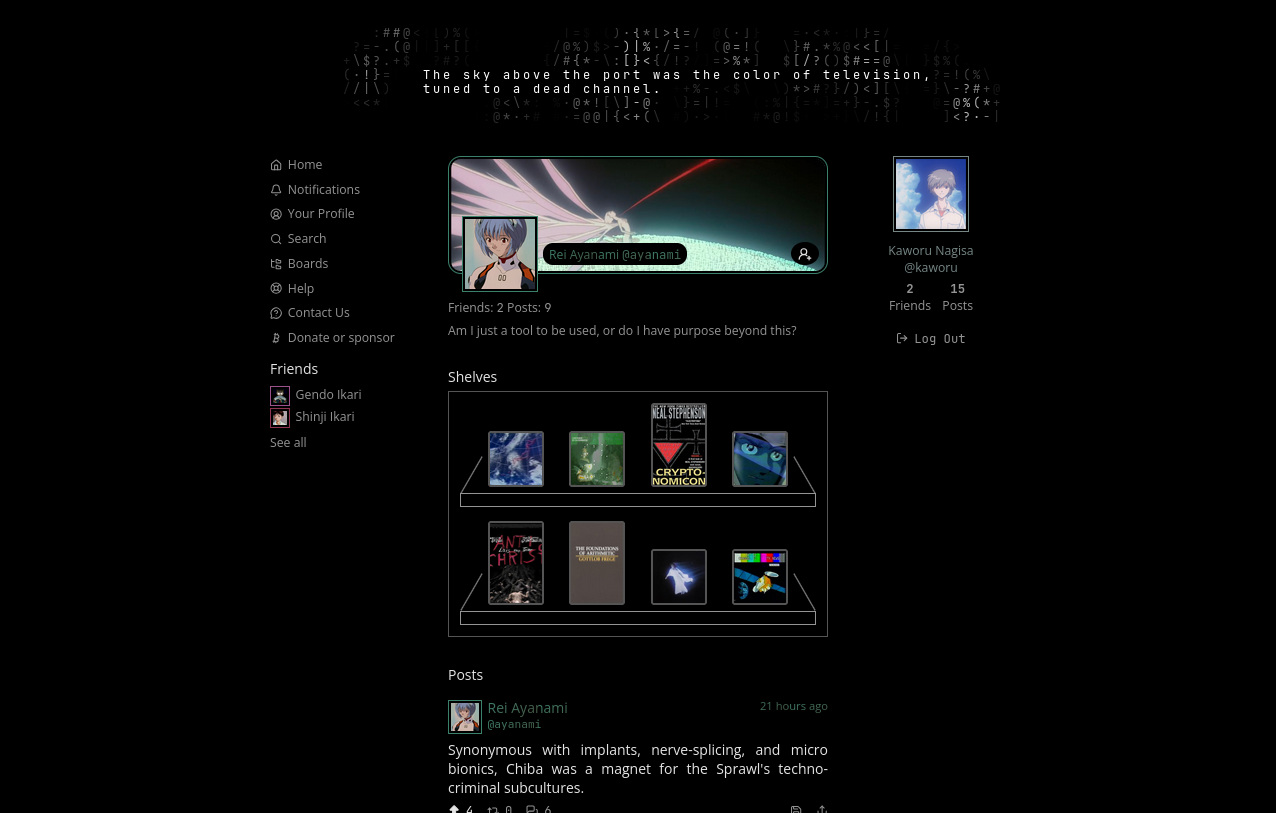
Shelves came out of a simple question: how can you make a profile more expressive than just handing the user a textbox? Text bios alone are generic and boring. What someone is currently reading, watching, or listening to says a great deal more. This became the Shelves feature - a search component querying three external APIs, OMDb for films, OpenLibrary for books, MusicBrainz for albums, with live suggestions and a display component that renders covers on physical shelves on a user’s profile.
The Tech Stack
The frontend is SvelteKit with Svelte 5. The backend is Hono. Bun is the package manager throughout, and it’s TypeScript end to end, with a shared types package the server and client both import from.
React invented the component model and the ecosystem owes it a great deal for that. But by 2026, it’s also carrying ten years of accumulated decisions: hooks, context, server components, concurrent rendering - and the complexity has stratified accordingly. For a new project, React tends to be chosen by default, because it’s what everyone knows and what the hiring pool expects, not because it’s the best tool for the problem. That’s reason enough to look elsewhere when you’re starting something new.
Next.js is the obvious full-stack answer, opinionated, and deployable to Vercel in a single command. The trouble is that last part. Vercel’s best features - ISR, image optimisation, edge functions - are platform primitives, not open standards, and the framework is coupled tightly enough to the platform that the cost model gets expensive as a project grows. For a project intentionally exploring the edge, that was exactly the wrong direction to be pulled in.
Svelte was the natural alternative. It compiles to vanilla JavaScript - no virtual DOM, no runtime overhead, smaller bundles, and Svelte 5’s runes replace the compiler-inferred magic of earlier versions with something more explicit. It’s more verbose in places, but you can see the reactivity doing what it does and that makes it easier to reason about.
Hono is a lightweight HTTP framework that runs natively on Cloudflare Workers with no Node assumptions baked in. It stayed out of the way throughout, which might be the best thing you can say about a framework.
Bun, I’m less sure about. It’s fast and genuinely pleasant to use day to day, installs are quick, the built-in tooling covers most of what you’d otherwise reach for separately, and working with files or hashing passwords natively, without importing anything, feels better than the equivalent in Node. I liked it - though I’ve come round to thinking Bun was probably the wrong choice for this particular project.
The problem is that Cloudflare Workers don’t run on Bun’s runtime, so
everything I liked about it turned out to be either unavailable in
production or gated behind compatibility flags. Native file operations
don’t matter, because Workers have no filesystem. Bun.password isn’t
available in the Workers runtime at all. What you’re left with is Bun as a
fast package manager, while none of the code that actually ships uses any of
its advantages - and the workarounds compound from there. Bun intercepts npx, so wrangler needs its own fix just to be invoked correctly.
Environment variable syntax changes depending on which command you’re
running. There’s still a case for Bun - local dev really is faster - but for
a project built on the edge, the package manager probably ought to be
aligned with the runtime it’s shipping to. Deno looks worth investigating
next time, since its runtime model sits closer to Workers, and I’ll likely
give pnpm a look too.
Drizzle as the ORM wasn’t entirely a free choice either. Prisma, the obvious pick for TypeScript, needs a persistent connection to a traditional database, which means it doesn’t run at the edge without a separate query proxy - and that rather defeats the point of the whole deployment model. Drizzle is edge-compatible, plays well with SQLite, and infers excellent TypeScript types straight from the schema. The honest assessment, though, is that it has rough edges. Complex joins come back as flat rows full of nullable fields you then have to dispatch by hand in TypeScript. For simple queries it’s clean; for anything with several joined tables, the result ends up more verbose and harder to follow than the SQL it’s standing in for. Given the constraints, it was the right call. But honestly, I’d look harder at the alternatives next time.
Deployment to the Edge
The server runs as a Cloudflare Worker - a serverless function that executes in whichever region is closest to the request, rather than a single origin server somewhere. There’s no infrastructure to manage, no server to keep alive, no CDN to configure separately. The code is globally distributed by default and scales without any capacity planning on my part, and because Workers are priced per request rather than per server-hour, a platform in early growth pays close to nothing. The same deployment handles ten users or ten thousand without a single configuration change.
The tradeoff is that Workers impose a genuinely restricted environment - no filesystem, a limited Node compatibility layer, a strict execution budget. None of that is a problem for a web API so much as it’s simply the shape of the problem you’re solving. You build around it.
The database is Turso, a managed SQLite service built on libSQL, a fork of SQLite with replication support. The model mirrors the Workers philosophy: replicas are distributed across regions, so queries run close to wherever they’re initiated. SQLite changes the mental model relative to Postgres too - there’s no connection pool to manage, no pgBouncer, no connection limits to tune, and for a small social platform that simplicity is a genuine feature. Drizzle sits on top of it, providing the typed schema and query builder.
Files go to Cloudflare R2, object storage without egress fees. In production, avatars and post media are served straight from a public R2 URL; in local development, the Worker proxies requests to a local R2 simulation, with a storage abstraction in the backend so routes never need to know which environment they’re actually running in.
One backend decision worth mentioning here: the posts feed uses
cursor-based pagination rather than offset. The standard approach - LIMIT 20 OFFSET 40 - produces inconsistent results the moment rows get
inserted mid-pagination, and it degrades further as the table grows. A
cursor uses a stable position marker instead, a combination of creation
timestamp and row ID, and the tradeoff is that you lose the ability to jump
to an arbitrary page. For a feed, nobody’s asking for that anyway.
Authentication
The standard choice for this stack would have been better-auth. It integrates cleanly with Hono, Drizzle, and Turso, and it handles sessions and OAuth providers well enough to get authentication out of the way quickly. I didn’t use it.
Authentication struck me as one of those things worth actually understanding rather than delegating, and the only way to understand it is to build it. The implementation went through a few iterations before settling on hono-sessions with a custom store backed by Turso: sessions are created on login, stored as rows in the database, and validated on each authenticated request by reading back from that store.
The alternative, stateless JWTs, is attractive precisely because it needs no storage - the token carries its own payload and signature - but session revocation is a lot simpler when the session actually exists somewhere you can go and delete it. For a platform with persistent accounts and login state, the database-backed session was easier to reason about, and better-auth remains a sensible library for anyone shipping a production project with multiple OAuth providers and an actual deadline. Just not for a project whose whole point was understanding what happens under the surface.
Schema Design
Shelf items come in three types - films, books, albums - and each pulls
from a different API with slightly different metadata attached. There were
two ways to model that. The first: a single shelf_items table with a type column, simple to query, no joins - single-table inheritance. The
second: a base shelf_items table with foreign keys out to separate films, books, and albums tables, normalised, with type-specific
fields always present - class table inheritance.
I chose the second, and the reasoning felt sound at the time. I’d just
built the notification system using the single-table approach and found it
genuinely painful. Notifications come in four types - friend requests,
friendship acceptances, post likes, comment likes - each carrying different
associated records, and the single table meant nullable foreign keys for
every variant: friend_request_id, friendship_id, action_user_id, post_id. Querying it meant aliasing the users table four times over and
writing CASE expressions into LEFT JOINs to make sense of the result. The
lesson seemed obvious enough: a single table with nullable fields becomes
hard to query the moment each type carries meaningfully different data.
The lesson was correct. I just applied it to the wrong problem.
Shelf items feel distinct but actually normalise cleanly to the same shape - title, subtitle, cover image, external ID is the whole interface - and the query for fetching someone’s shelf ended up being three joins that never needed to exist:
const rows = await db
  .select({
    id: shelfItems.id,
    type: shelfItems.itemType,
    filmTitle: films.title,
    filmYear: films.year,
    bookTitle: books.title,
    bookAuthor: books.author,
    albumTitle: albums.title,
    albumArtist: albums.artist,
    ...
  })
  .from(shelfItems)
  .leftJoin(films, eq(films.id, shelfItems.filmId))
  .leftJoin(books, eq(books.id, shelfItems.bookId))
  .leftJoin(albums, eq(albums.id, shelfItems.albumId))
  .where(eq(shelfItems.userId, userId));
Every field comes back nullable, because the row came from a left join, so
the mapping code has to check row.type and cast accordingly. A single
table would have given me one query, no joins, no nullable dispatch:
const rows = await db
  .select()
  .from(shelfItems)
  .where(eq(shelfItems.userId, userId));
Notifications, by contrast, genuinely do vary - different relationships, different associated records, different query requirements for each type - and separating them out would have simplified every query I write against that table.
So the right pattern ended up in the wrong place, and the wrong pattern in the right one. What I actually learned wasn’t “are these different types?” but something closer to: do these types have meaningfully different data you’ll need to query separately? Shelf items don’t. Notifications do. Getting it backwards taught me the distinction more thoroughly than getting it right the first time would have.
Building Without AI
This was a learning project, so AI played a minimal role in most of it. AI has its place if you’re building quickly, but only once you already understand enough to tell whether it’s making the right choices. You still need the understanding first, and the way you get it is the old way - by building the thing yourself.
Deployment was the one place I made an exception, and I used Claude Code deliberately for it - plan mode throughout, auto-accept off. The point wasn’t to have the deployment done for me so much as to have an assistant in the room who actually knew what they were talking about. Configuring Workers, working out the Turso authentication model, figuring out why the server hangs when wrangler gets invoked through Bun - these are slow feedback loops with opaque failure modes, and that’s exactly the kind of work where it made sense to bring AI in.
The distinction I want to draw is between implementation and understanding. AI as a guide explaining what’s happening and why earns its keep on operations work, where the learning comes from the explanation rather than the typing. For application development, the typing is the learning, and that’s not something worth outsourcing.
What’s Next
Lemuria is live in demo mode at lemuria.pages.dev. Boards, search, and several other features are planned. The codebase is at github.com/fidzod/lemuria.